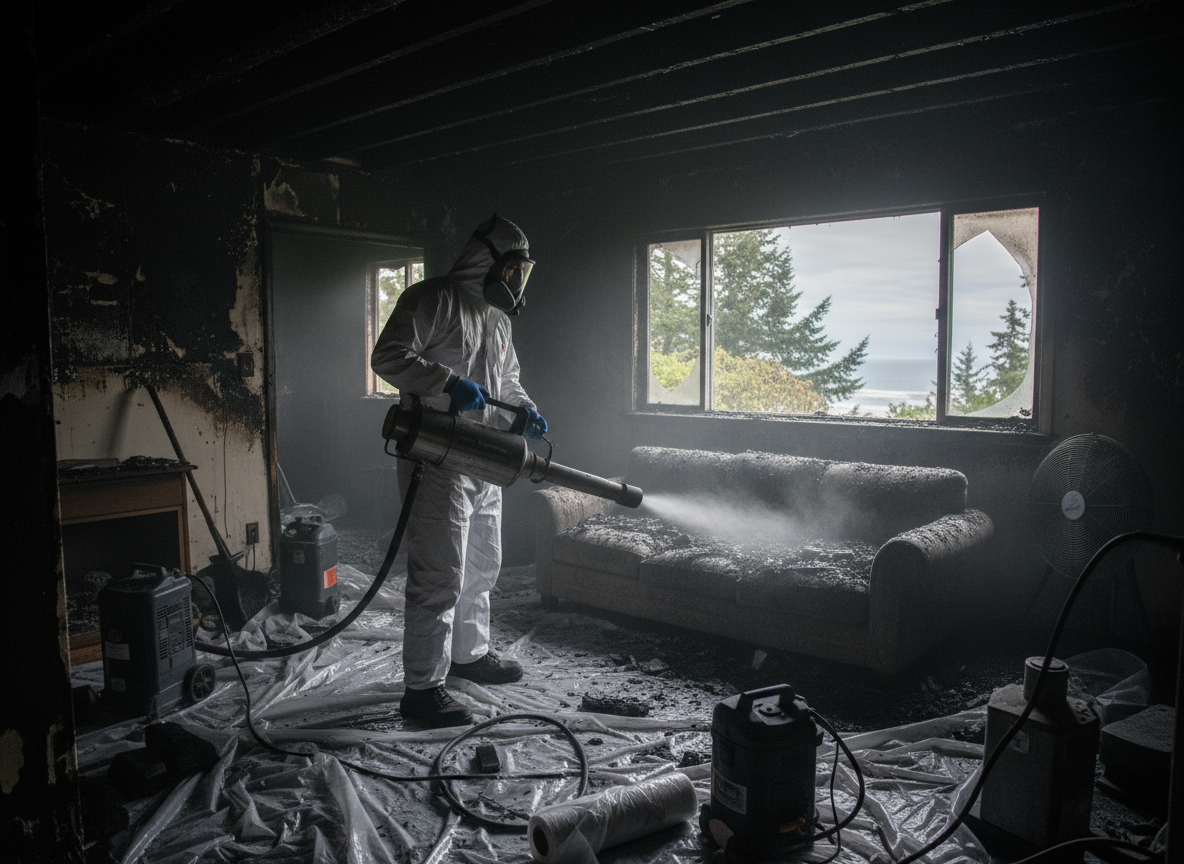
Smoke from structure fires in Seahurst homes often penetrates porous materials like lathe-and-plaster walls common in mid-century houses along Ambaum Boulevard and nearby Burien borders. Residual odors linger in insulation, subfloors, and ductwork because coastal humidity slows natural off-gassing. Technicians begin by mapping odor paths with thermal imaging and air sampling to locate hidden deposits before any masking agents are introduced. Failure to address these pockets leads to recurring smells after the first heavy rain, a frequent complaint in King County properties built before 1970.
Effective treatment combines source removal with advanced oxidation. After removing charred debris and HEPA vacuuming loose soot, crews apply thermal fogging or hydroxyl generators that break down odor molecules at the molecular level rather than covering them. In Seahurst homes with forced-air systems, ducts require separate cleaning and sealing because marine air carries moisture that reactivates trapped hydrocarbons. Drywall sections showing deep staining are often cut out instead of sealed, preventing future bleed-through once humidity rises again in fall.
Verification includes repeat odor testing after treatment and a 48-hour observation period under normal household conditions. Homeowners in the Seahurst area are advised against running HVAC until clearance because recirculating air can redistribute any remaining particulates. Final walkthroughs confirm no detectable smoke scent in closets, attics, or crawl spaces where older homes frequently trap residues.
Technician insight
In Seahurst, the thing that catches most people out with Odor removal after fire is how the older wooden homes along Ambaum Boulevard trap soot in the crawl spaces due to our damp coastal air, which homeowners often miss until the smell returns after a rain.
Attic Fire Odor in Seahurst Residence
Problem: smoke from an attic electrical fire migrated into second-floor bedrooms. What we found: soot lodged in fiberglass insulation and plaster walls of a 1960s home. What we did: removed contaminated insulation, treated cavities with hydroxyl generators, and cleaned shared duct runs. Outcome: no detectable odor remained after final testing.
How it works
- 1
Initial Odor Mapping
Technicians inspect all affected rooms, HVAC runs, and structural cavities using detection equipment to trace smoke migration paths specific to the property's construction.
- 2
Source Removal
Charred materials and heavily contaminated insulation are removed, followed by HEPA vacuuming of remaining surfaces to eliminate loose soot particles.
- 3
Deodorization Treatment
Thermal fogging or hydroxyl processing is applied throughout the structure, targeting embedded odors in porous materials and ductwork.
- 4
Verification and Clearance
Air quality is retested after treatment, with a follow-up visit to confirm odors have not returned under normal living conditions.
Pricing
Pricing varies by square footage affected, depth of smoke penetration, and whether HVAC cleaning is required; upfront assessments are provided before work begins.