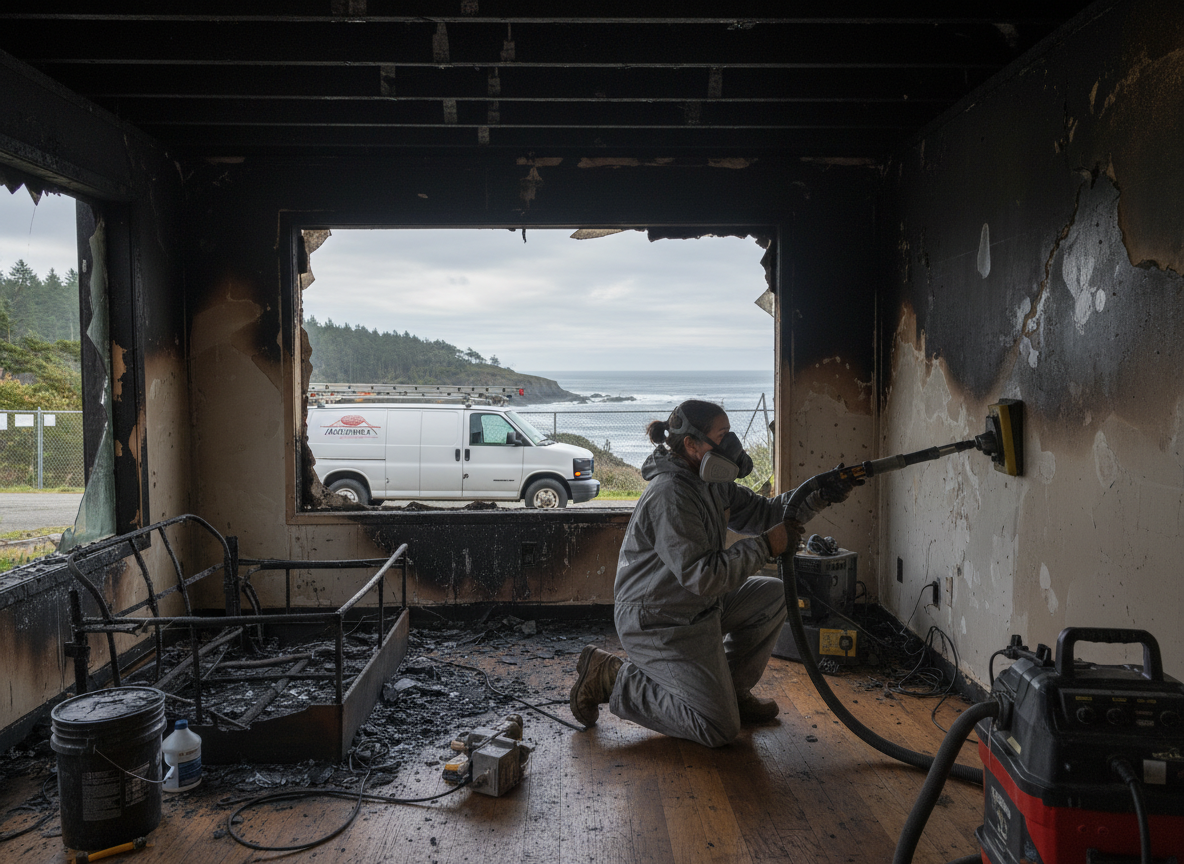
Seahurst homes, many built between 1950 and 1975 along Ambaum Boulevard and nearby streets in King County, often feature wood framing and older HVAC systems that allow smoke to travel through walls and ducts. After a fire, residual soot bonds to these surfaces and can react with the frequent coastal moisture that moves in from Puget Sound, creating hidden corrosion on wiring and metal components. Restoration crews must open cavities early and use moisture meters to prevent secondary mold growth once the dry season ends.
King County building codes require permits for any structural work after fire damage, and Seahurst properties near the water table can see water intrusion if suppression efforts saturate crawl spaces. Technicians test for asbestos in older insulation before demolition and coordinate with local inspectors to avoid delays. Skipping these steps risks failed final clearances and extended displacement for homeowners.
Portable power and negative-air machines are standard on Seahurst jobs because many streets lack easy access for large equipment. Crews also account for salt-laden air accelerating rust on restored metal fixtures, a factor that shows up more in homes within a mile of the shoreline than in inland Burien or Tukwila properties.
Technician insight
In Seahurst, the thing that catches most people out with fire damage restoration near me is how quickly salt air from the sound starts corroding copper wiring and galvanized ducts once soot is present, especially in homes built before 1970 along Ambaum and 1st Avenue. Homeowners often skip pulling the HVAC apart early and end up replacing entire systems later when the corrosion shows up after the first big rain.
Soot Migration in Pre-1970 Crawl Space
A fire started in a kitchen on 4th Avenue SW; smoke traveled through floor joists into the crawl space. We found heavy soot on insulation and wiring that had already begun to corrode from coastal moisture. We opened the floor, cleaned and treated the space, replaced affected wiring, and dried the area before closing it back up.
How it works
- 1
Emergency Board-Up and Site Security
Secure openings and tarps installed same day to prevent weather damage and unauthorized entry at Seahurst addresses.
- 2
Soot and Smoke Assessment
Thermal imaging and air sampling locate residue in walls, attics and HVAC systems typical of local mid-century construction.
- 3
Contents Cleaning and Odor Removal
HEPA vacuuming, ultrasonic cleaning and ozone or hydroxyl treatment performed on site or at our facility.
- 4
Structural Drying and Reconstruction
Moisture extraction followed by permitted repairs using materials matched to original construction in King County.
Pricing
Upfront quotes provided after on-site evaluation; cost driven by square footage affected, smoke migration into HVAC, and any required permits.