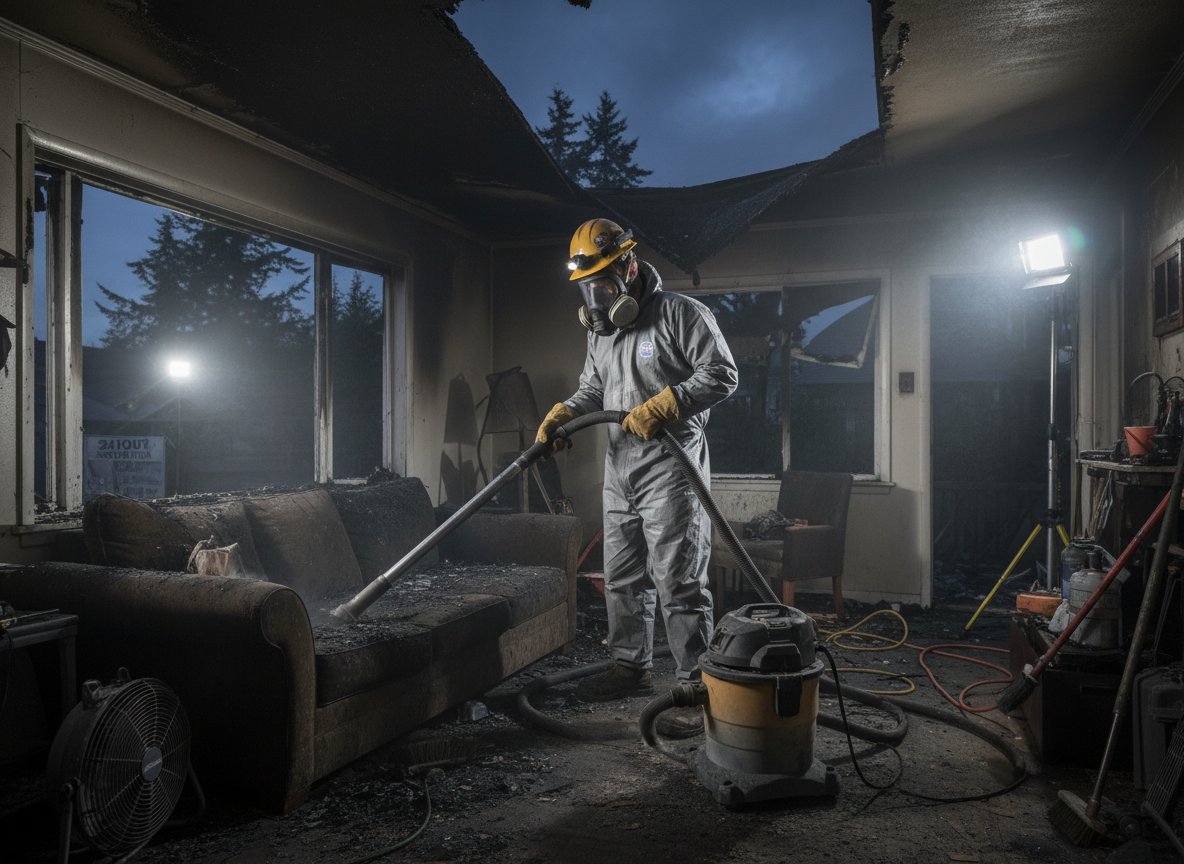
Seahurst homes built in the 1950s and 1960s along Ambaum Boulevard and nearby streets often contain plaster walls over lath and older electrical systems that allow fire and smoke to travel into concealed cavities. A 24 hour fire restoration response begins with boarding and tarping to prevent rain from the Puget Sound region from entering through roof breaches, then moves to HEPA air scrubbing to capture acidic soot before it etches glass and metal fixtures common in mid-century kitchens.
Water used by firefighters on steep lots near Seahurst Park can pool against foundations, creating hidden moisture pockets that must be mapped with thermal imaging within the first 24 hours. Crews from the 15201 Ambaum Blvd SW location carry portable generators and negative-air machines sized for single-story ramblers typical in the neighborhood, allowing work to continue through power outages that frequently follow structure fires.
Edge cases include residue from burning cedar siding and asphalt shingles, both prevalent on older Seahurst properties, which produce heavy, oily soot requiring specialized degreasers rather than standard detergent cleaning. Delaying extraction of charred insulation can allow odors to migrate into HVAC ducts shared with neighboring homes on narrow lots.
Code considerations arise when fire damage affects load-bearing beams in crawl spaces; restoration must coordinate with King County inspectors before any structural repairs begin, especially on properties close to the shoreline where soil conditions add extra scrutiny.
Technician insight
In Seahurst the thing that catches most people out with 24 hour fire restoration is how quickly rain soaks into the voids behind original cedar siding on 1960s homes along 1st Avenue SW; if you wait even one day the water mixes with soot and forces full wall replacement instead of surface cleaning.
Kitchen Fire in 1958 Rambler
A cooking fire spread through a wall shared with the utility room on a narrow lot off Ambaum. Crews found heavy smoke residue inside the original knob-and-tube wiring chase and standing water in the crawl space from suppression efforts. Immediate extraction, drying, and soot removal prevented further corrosion of copper pipes and allowed the family to return within ten days after minor electrical updates.
How it works
- 1
Emergency Board-Up and Site Security
Technicians arrive within hours, secure openings, and install weatherproof barriers to protect against Seahurst rain.
- 2
Soot and Smoke Assessment
Thermal imaging and air sampling identify hidden residue paths through older wall cavities and attic spaces.
- 3
Contents Removal and Cleaning
Salvageable items are packed out, catalogued, and treated off-site while structural cleaning proceeds.
- 4
Odor Neutralization and Drying
Ozone or hydroxyl generators combined with dehumidification address persistent smoke smell in damp coastal air.
- 5
Final Clearance and Reconstruction Planning
Air quality testing confirms safe re-entry before any rebuilding work begins.
Pricing
Pricing depends on fire size, affected square footage, and extent of smoke migration into older construction; written estimates are provided on-site before work begins.